


Bogged down in the details
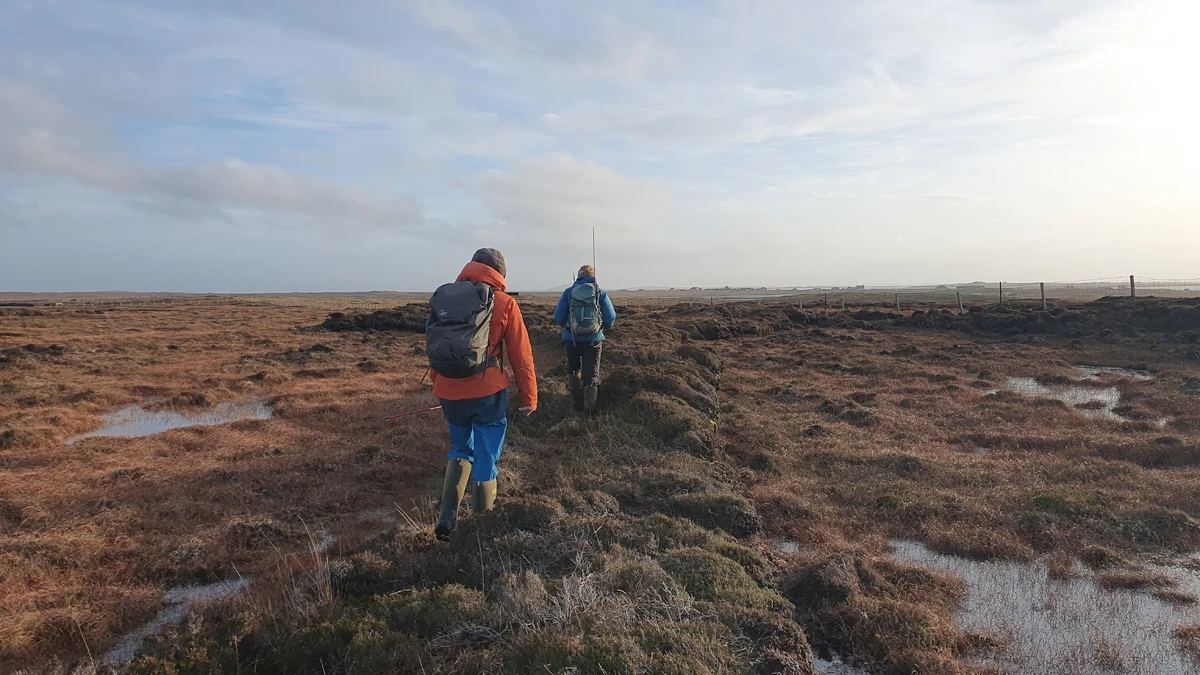
All peatland projects are underpinned by fieldwork; time spent on the bog is essential to develop an understanding of the land you’re aiming to restore and the impact the project will have in the long run. But what do developers need to do to create a robust peatland restoration project?
In this blog Environmental Consultant, Joanna Maclennan, explores the importance of a ground-truthing visit in informing the development process. Caledonian Climate surveys all over Scotland; from the vast flow country in Caithness, to the rolling hills of the Borders and the windswept islands of the Hebrides - no one site is the same.
A crucial step in the development process, ground-truthing surveys give the project developer a chance to carry out a more thorough analysis of features on the ground and any constraints identified during the desktop study. This enables our team to refine the project which is essential to mitigate future variance and secure the best possible delivery of our projects.
During the ground-truthing visits, our surveyors are equipped with erosion mapping data viewed on a handheld device. This details the features and interventions identified during the initial mapping, which is primarily based on aerial imagery. Unfortunately, at this stage the mapping will never be 100% accurate, seeing the features on the ground provides invaluable insight which can’t always be identified during the initial desktop study.
Alongside checking the features planned for restoration, access is another key priority to look at - can machines safely track across the soft areas and around lochans? Are there fences to compete with? And how many? Which areas are grazed for livestock? Are there powerlines? It all comes into play.

Figure 1 - The gate to nowhere - No access constraint here!
Many of our sites overlap with protected areas, these may be designated for nationally important habitat, such as pools systems, extensive blanket bog or woodland - or they may be designated for protected species. Scottish peatlands are home to a range of fauna - birds, mammals, reptiles, amphibians and invertebrates all call the bog home. It is essential that restoration projects do not negatively impact these species during works - as such, species present must be identified. The ground truthing survey gives us an opportunity to do that.
The variety of species we encounter during surveys is a real highlight for me. Sometimes, there's nothing better than looking up to see an eagle fly overhead or a golden plover eyeing you on their lookout. In a recent survey, our team (pictured above) had some fantastic encounters.
Our field coordinator Lizzie, said: "For January, the place was packed with a surprising amount of wildlife. Within the first hour, one surveyor spotted a white tailed eagle, and over the following days both male and female Hen Harrier hunting diligently over the peatland, numerous otter runs and spraints and a 7-pointer antler were checked off the list."
Ground-truthing visits are a great way for the Caledonian Climate team and wider surveyors to deepen their understanding of restoration projects. Being able to discuss project complexities, such as which techniques are best suited to complex or unique features, provides context that may be overlooked during initial surveys.
One of our team, Cat, who has recently joined us as a PeatlandACTION intern, shared some thoughts on her first ground-truthing survey: “Up until now, I’d been involved in feasibility surveys and erosion mapping, so bringing those elements together in practice gave me a much clearer understanding of how the different stages of assessment connect on the ground.”

Figure 2 - A somewhat atypical form of peat cutting, providing an interesting challenge for restoration.
Figure 2 above shows a feature that was not initially picked up during the desktop study. Deep scars were created using a peat cutting machine, which has dried and opened up over time. Personally, having never seen this type of feature before, I was happy to have the other members of the team on site to troubleshoot what restoration interventions could potentially be suitable here.
And lastly, the ideal way to finish any survey? Watching the sunrise on the horizon after a CalMac breakfast (if you know you know).
For more news and insight on our peatland restoration work, click here or follow us on Instagram and LinkedIn.
For more information on this article, please contact:
Freddie Ingleby
Managing Director
+44 (0) 7840 998 944
freddie@caledonianclimate.com
About Caledonian Climate
Working responsibly with the custodians of Scotland’s beautiful countryside, Caledonian Climate is committed to tackling the twin crises of climate change and biodiversity loss.
To achieve this, we talk to forward-thinking businesses who want to fulfil their ambitions for carbon emission reductions through high-quality carbon credits with multiple co-benefits. We then partner them with landholders in the Scottish Highlands, maximising the ecological value and sustainability of their estates.
Building on our significant experience, and guided by a distinguished Advisory Board, Caledonian Climate is delivering the benchmark for long-term restoration of Scotland's degraded peatlands, locking away the carbon for good.
Our work also enhances biodiversity, improves water quality, boosts local economies and creates a compelling story for all of our partners to share.