


Trust at scale: Embedding AI responsibly in peatland restoration
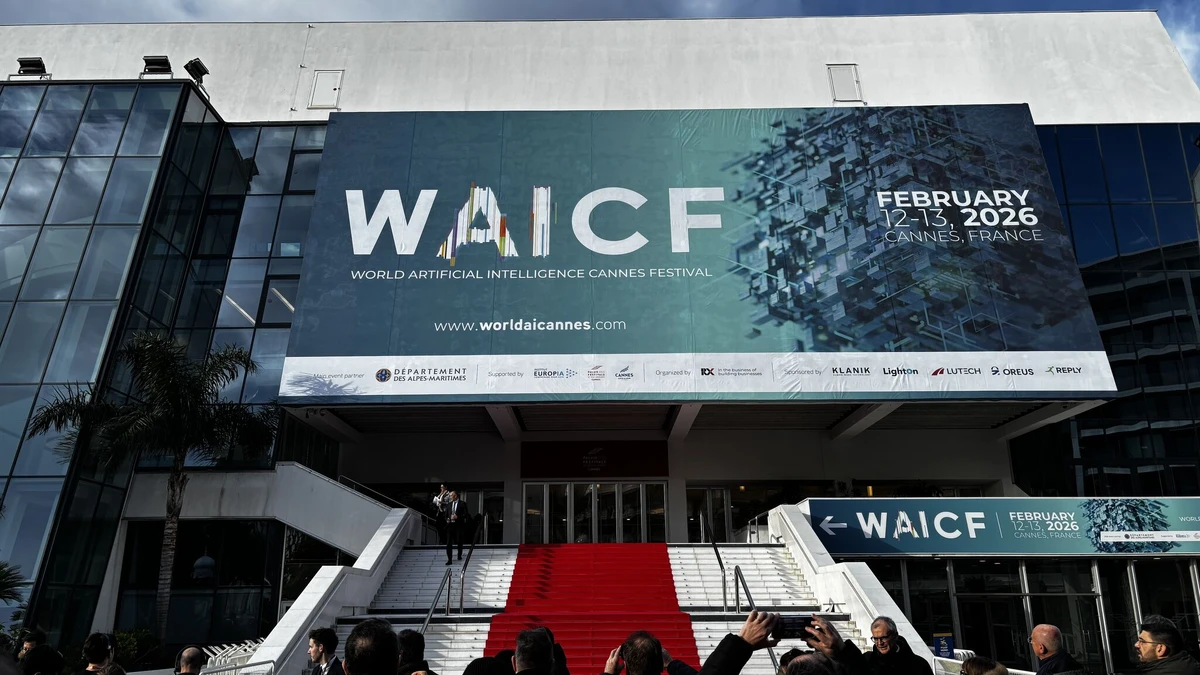
Earlier this month, our Operations Director, CJ MacLeod, attended the World AI Cannes Festival with Scottish Enterprise, Highlands and Islands Enterprise, and South of Scotland Enterprise.
We spoke to CJ about his key learnings from the event and his view on how AI will transform peatland restoration in Scotland and beyond.
What was your biggest takeaway from the festival?
My biggest takeaway was that the real shift to AI isn't about tools, it's about operating models, and that landed with real clarity for Caledonian Climate (CCP). Across conversations with global tech leaders, scale-ups and policymakers, it became clear that AI maturity is about governance, not experimentation. Too many organisations are treating AI like a software upgrade when it's actually an organisational revolution, and the nature-based solutions sector is no different.
At CCP, we're already navigating the complexity of scaling peatland restoration across Scotland, managing field data, carbon standards, funding compliance and stakeholder accountability simultaneously. What the conference reinforced is that AI doesn't create new problems, it reveals the ones you already have: inefficient processes; data gaps; fragmented reporting. For us, that's not a threat, it's an opportunity to build something better.
The question we came home with isn't "Should we adopt AI?" it's "How do we embed it in a way that strengthens our delivery and protects trust in what we do?"
From your learnings, how can AI strengthen the delivery of peatland restoration and the measurement of project outcomes?
At CCP, delivery credibility is everything. Our funders, carbon market partners and regulatory stakeholders need confidence in the accuracy of our reporting and that our data stands up to scrutiny. The conference reinforced that the most valuable AI applications are often the unglamorous, repetitive, data-heavy tasks that consume disproportionate time and resource. For us, that means automating field data validation, standardising carbon and funding reporting, and reducing manual admin so our technical teams can focus on higher-value work.
The verification of restoration outcomes is a particular priority, as the current process is labour-intensive and difficult to sustain at scale. AI offers a way to increase efficiencies, consistency and auditability, directly strengthening our credibility in carbon markets, while maintaining human oversight throughout. Traceability, evidence and independent audits aren't optional for CCP - they're part of what makes our work trustworthy.
How can nature-based solution organisations get it right with AI?
The honest answer is that most organisations, including those in the NBS sector, are at risk of getting AI implementation wrong by moving too fast without sufficient direction. The conference gave a clear roadmap that we're taking seriously at CCP:
- Start with your "Why": what specific operational or delivery problem are you solving? At CCP that means being deliberate; we're not launching AI across every function all at once. We're identifying a number of cases where it will have the most meaningful impact on delivery quality and operational efficiency.
- One thing I observed that resonated strongly was the rise of shadow AI, employees experimenting privately because governance hasn't kept pace with enthusiasm. For a mission-driven organisation like CCP, where the integrity of our carbon and biodiversity outcomes is non-negotiable, that's a real risk. AI must be embedded into our workflows, culture and leadership, not left to individuals to figure out in isolation.
- Responsibility always sits with the organisation. For us, that means leadership owning this agenda directly, not delegating it, and building governance that protects the trust our partners place in us.
What role could AI play in scaling peatland restoration in the UK and globally?
This is where the opportunity feels most significant for CCP. Scaling peatland restoration isn't just about planning more, it's about managing complex, multi-site programmes with consistent data quality, rigorous carbon accounting and funding compliance, all simultaneously. That's an enormous coordination challenge, and one where AI can genuinely help.
We're moving toward agent-led systems that don't just assist decisions but reason and act autonomously, and within five years, that capability could allow CCP to coordinate restoration at a scale that simply isn't possible manually.
One discussion that stood out explored AI combined with blockchain, with direct implications for carbon market traceability. For CCP, that combination could be transformative: digital capability is increasingly inseparable from environmental credibility.
What impact do you think AI will have on the nature recovery sector in 5-10 years-time?
For CCP, the future includes the incorporation of AI into our core delivery infrastructure, through field data collection, hydrological modelling and funder reporting - not a separate capability. The shift to agent-led systems is already underway, and for us, that makes traceability, verification and auditability increasingly non-negotiable.
Within ten years, the organisations leading in peatland restoration will be those that integrated AI early and responsibly. One of the standout moments of the conference was a live demonstration of a tool that had been built entirely around AI from day one — not adapted, not retrofitted, but conceived and constructed with artificial intelligence at its very core. Developed using a GenAI platform and powered by multiple AI models working in harmony through a central intelligence layer, it offered a glimpse of just how transformative this technology could be for the sector.
In conclusion, none of this works without leadership and at CCP, we've been deliberate about that. AI isn't something we're delegating to a single team member or treating as a technology project, it's a strategic priority that touches how we deliver, how we report, and how we build trust with the partners and funders who rely on the integrity of our work. Across every session at the festival, one word kept resurfacing: trust. Trust in systems, trust in data, trust in intent. For an organisation like CCP working in carbon markets, managing public and private funding and making environmental claims that need to stand up to independent scrutiny, trust is everything.
AI maturity for us isn't about how many tools we test. It's about how clearly we define our purpose, how carefully we prioritise, and how responsibly we embed AI into the way we work. This isn't a tech shift, it's an operating model shift and we're committed to getting it right.
Huge thanks to CJ for sharing his insights with us from the World AI Cannes Festival. To hear more from CJ, click here.
If you have any questions about Caledonian Climate’s approach to large-scale peatland restoration, get in touch.
For more information on this article, please contact:
Freddie Ingleby
Managing Director
+44 (0) 7840 998 944
freddie@caledonianclimate.com
About Caledonian Climate
Working responsibly with the custodians of Scotland’s beautiful countryside, Caledonian Climate is committed to tackling the twin crises of climate change and biodiversity loss.
To achieve this, we talk to forward-thinking businesses who want to fulfil their ambitions for carbon emission reductions through high-quality carbon credits with multiple co-benefits. We then partner them with landholders in the Scottish Highlands, maximising the ecological value and sustainability of their estates.
Building on our significant experience, and guided by a distinguished Advisory Board, Caledonian Climate is delivering the benchmark for long-term restoration of Scotland's degraded peatlands, locking away the carbon for good.
Our work also enhances biodiversity, improves water quality, boosts local economies and creates a compelling story for all of our partners to share.

